
Dirt Road Driving in South Africa - A Car Protection Guide for Rural Roads
Sandy road corrugations do not care about your car’s service plan.
Ask a farmer outside Bethlehem, a game ranger in the Lowveld, or anyone doing a fortnightly grocery run down a gravel road in the Karoo, and the same complaint comes up: chipped paint on the bonnet, a rattling underbody, and shock absorbers that need to be replaced years earlier than the manual suggests.
Dirt roads are just another part of life for many South African drivers. And if you are one of those who go bouncing down the road during the dry season, this guide to protecting your car is just for you.
The Damage Caused By Rough Dirt Roads
South Africa’s road network covers roughly 750 000 kilometres, and government estimates place well over 300 000 kilometres of that as unpaved gravel, much of it carrying rural and farming traffic every day.
The national network managed by SANRAL runs to about 21 000 kilometres, with provinces and municipalities responsible for the far larger share of unpaved roads that most rural drivers actually use.
Research from Frost & Sullivan found that more than half of the country’s unpaved roads sit in poor to very poor condition, which means corrugations, potholes and loose stone are the norm rather than the exception on a rural commute.
Roads in such conditions give cars 3 very troublesome problems.
Stone chips strike the bonnet, front bumper, mirrors and headlights at speed, wearing away paint and clear coating over time.
Moisture, grit and road salt work their way into the underbody, where corrosion sets in and often goes unnoticed until a service reveals the damage.
And corrugations shake suspension components at a rate they were never designed for, wearing out shocks, bushings and joints well before their usual lifespan.
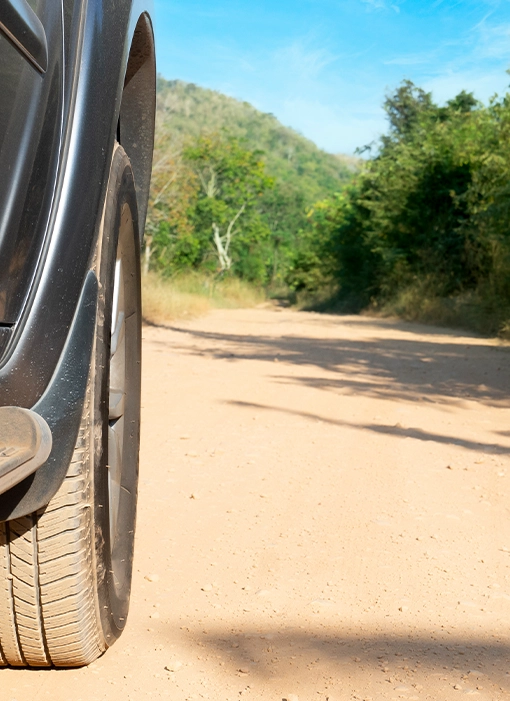
Matching Protection to the Way a Car is Actually Driven
The right protection for a dirt road vehicle depends on a few factors, like how often it travels on gravel, and what kind of terrain it covers. The lifespan of the car protection product will also be important.
A car doing an occasional gravel stretch has different needs to a bakkie that lives on farm roads, so it helps to think in terms of driving pattern rather than a single generic checklist.
Daily rural commuting.
Where the main risk is cosmetic damage from following distance and speed, paint protection film on chip-prone panels, such as the bonnet, front bumper and mirrors, absorbs the impact before it reaches the paint underneath. Modern film also includes self-healing properties, so light scratches on the film itself fade with warmth from the sun.
Farm, game or river-crossing routes.
Where moisture, mud and stone strikes from underneath are the bigger concern, underbody rubberising forms a protective barrier against corrosion and impact damage. A bull bar or nudge bar adds front-end protection against livestock and wildlife, a real risk on unfenced rural roads, and often doubles as a mounting point for extra driving lights.
Frequent or long-distance gravel travel.
Where corrugations are a daily reality rather than an occasional stretch, a suspension kit built for rougher terrain reduces premature wear on shocks and bushings, and improves handling and tyre wear over the vehicle’s life.

| Protection type | What it guards against | Best suited to |
|---|---|---|
| Paint protection film (PPF) | Stone chips and scratches on paint, bumpers and headlights | Daily rural commuting on gravel |
| Underbody rubberising | Corrosion, moisture and stone impact under the chassis | Farm, game or river-crossing routes |
| Bull bar or nudge bar | Front end damage from livestock and wildlife strikes | Rural roads shared with animals |
| Suspension kit | Premature wear from corrugations and potholes | Frequent or long distance gravel travel |
None of these products works well as a single fix applied without some thought being given.
A fitment centre with real experience in rural vehicle protection, such as Protect-a-Car, can assess a specific vehicle and its usual route, then match a combination suited to both the terrain and the budget, rather than fitting everything a brochure lists.
A car built for gravel from the outset copes with dirt roads for years rather than months, and that difference shows up at resale as much as it does on the drive home.
Frequently Asked Questions
What is the best car protection for dirt roads in South Africa?
A combination usually works better than a single product for rural drivers. Paint protection film handles stone chips, underbody rubberising handles corrosion and impact, and a suspension upgrade handles corrugations, with the right mix depending on how often and how far a vehicle travels on gravel.
Does paint protection film work on gravel roads?
Paint protection film is a clear polyurethane layer applied over vulnerable panels such as the bonnet, front bumper and mirrors, designed specifically to absorb the stone chips that gravel roads throw up at speed, so the film takes the damage instead of the paint underneath.
How much does underbody rubberising cost in South Africa?
Pricing depends on vehicle size, the area covered and the coating thickness used, so figures vary between fitment centres and vehicles. A quote based on the specific vehicle and driving pattern gives a far more accurate figure than a general estimate.
Do bull bars help with dirt road driving?
Bull bars add a layer of protection at the front of a vehicle, reducing damage from impacts with livestock, kudu or other wildlife that regularly cross unfenced rural roads, and many designs also provide a mounting point for additional driving lights.
How often should suspension be checked on a car driven on gravel roads?
Vehicles used regularly on corrugated or unpaved roads need suspension checks more often than the interval suited to tar road driving, since corrugations accelerate wear on shocks and bushings. A vehicle’s handbook gives a baseline, and a specialist can adjust that based on actual road conditions.


